
Portable ladders are used at home and at work, yet many people are unaware that these simple products are governed by a detailed safety standard. BS EN 131‑1:2015 +A2:2025 is the first part of the EN 131 series and defines the terminology, ladder types and functional sizes that designers must follow. It sits alongside EN 131‑2 (requirements and testing) and EN 131‑3 (marking and user instructions) and has been mandatory since 2019.
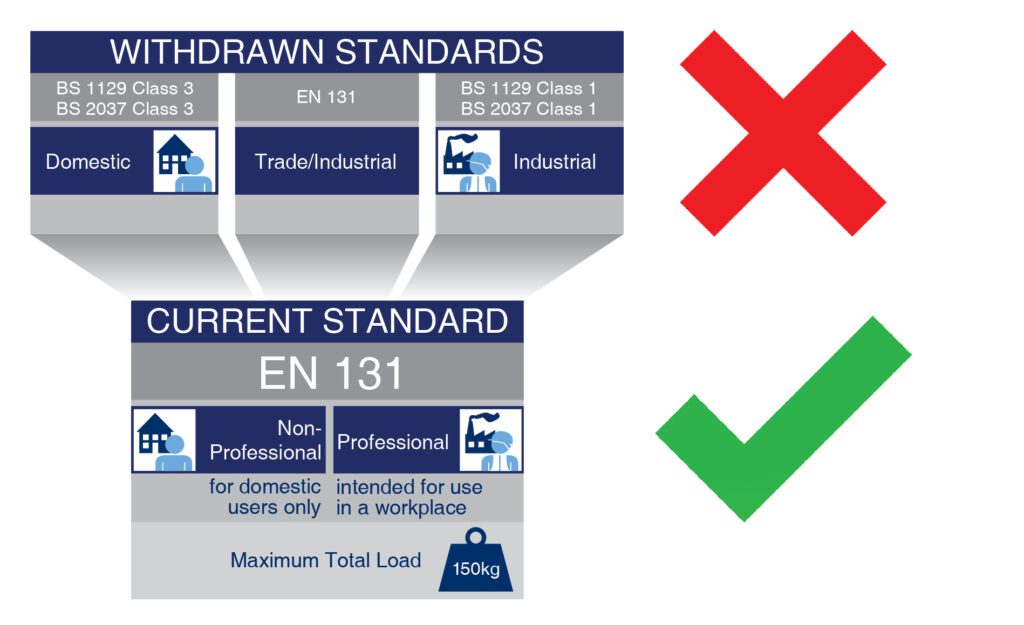
When you choose a new ladder, you expect it to be safe. Under the old British standards BS 2037 and BS 1129 there were different classes of ladders; these have now been withdrawn and all new ladders should conform to EN 131.
The EN 131 revisions made ladders wider, stronger and more stable. They also introduced two categories: Professional and Non‑professional. Both categories have the same maximum load rating (150 kg), but professional ladders are designed for tougher, more frequent use. Non‑professional ladders are intended for occasional DIY and should not be used in a work environment.
The standard covers all portable ladders designed for general use. Its scope states that the document “defines terms and specifies the general design characteristics of ladders”. It applies to portable ladders for both professional and non‑professional use, but not to ladders “limited only for a specific professional use”. Other parts of EN 131 or separate standards apply to single or multi hinge-joint ladders (EN 131-4) telescopic ladders (EN 131-6), mobile ladders with platforms (EN 131-7), step stools (EN 14183) and ladders for low volage live electrical work (EN 50528).
BS EN 131‑1 begins with “definitions”, ensuring that everyone uses the same language and terminology. Some of the most important terms are explained below (phrased in everyday language):
| Term | Simplified definition |
|---|---|
| Ladder | A device with steps or rungs on which a person climbs up or down. |
| Portable ladder | A ladder light enough to be transported and set up by hand. |
| Sectional ladder | A leaning ladder made of several sections that fit together; its length can only be varied by adding or removing whole sections. |
| Extending ladder | A leaning ladder made of two or more parts where the length can be adjusted one rung at a time. When the upper sections are moved by hand it’s called a push up extending ladder; when extended by a rope it’s a rope-operated ladder. |
| Standing ladder | Any ladder (with rungs or steps) that supports itself. A standing rung and step ladder has rungs on one side and steps on the other. |
| Step ladder | A ladder with wide steps that remain horizontal during use, providing a standing surface at least 80 mm deep. A standing step ladder is a two-legged, self-supporting version that may have a platform and hand/knee rail. |
| Standing rung ladder | A two-piece, self-supporting ladder with rungs on both sides; it can be climbed from one or both sides. |
| Combination ladder | A multi-part ladder that can be configured as an extending ladder, a standing ladder or a standing ladder with an extending section. |
| Stile | The lateral part of the ladder that supports the rungs or steps. |
| Rung | A climbing support with a front-to-back surface of 20–80 mm; a step is 80 mm or wider. |
| Platform | The topmost standing surface on a standing step ladder, distinct from a step. |
| Ascending leg / supporting leg | The ladder leg with climbing supports (rungs or steps) and the leg without them. |
| Hand/knee rail | Device at the upper end of a standing ladder for holding onto or bracing against. |
| Cross strut & bottom brace | Horizontal connections on supporting legs and a device that braces the bottom of the stile against buckling. |
| Opening restraint & locking device | Devices that prevent the two legs of a standing ladder from spreading apart and keep ladder hooks engaged on the rung or step. |
| Hinge joint & foot | A hinge that connects the two legs of a standing ladder, and a foot or non-slip cap fitted to the bottom of a ladder to prevent slipping. |
These definitions provide the foundation for the dimensional and design rules that follow.
General rules
Rungs and steps must be equally spaced with a tolerance of ± 2 mm. If a ladder can be dismantled without tools, each section must still meet the requirements of a one‑piece ladder.
Leaning rung ladders
For leaning rung ladders, the standard specifies a minimum base width derived from a formula (b₂) so that the ladder does not become too slender as it gets taller. Multi‑hinge and combination ladders used in a leaning mode must also meet this base‑width requirement. The method of providing this width – for example through a stabiliser bar or flared feet – is left to the manufacturer, but it must be permanently incorporated and not rely on removable accessories. This change is why newer ladders often have a stabiliser bar on the bottom.
Standing step ladders
Standing step ladders are self‑supporting and require special features:
The standard also defines minimum platform sizes and height ranges, but the key message is that standing step ladders must be robustly braced and provide a secure platform for the user.
BS EN 131‑1 lays the groundwork for safer ladders by defining consistent terms, types and critical dimensions. It requires evenly spaced rungs and steps, a wide base to improve stability and robust restraints on standing ladders. The revised EN 131 standard improves safety and harmonises requirements across Europe, while allowing national deviations where necessary.
Whether you are a ladder user, manufacturer or safety professional, understanding BS EN 131‑1 helps you choose and use ladders responsibly.
For full compliance and assurance, consider having your ladders tested and certified by Test & Research Centre – we’re here to help you climb safely!
34 Regal Drive, Soham, Cambridgeshire, CB7 5BE.
A UK-based Certification Body, Test Laboratory and training facility that specialises in access equipment.