

CASE STUDY
‘Step Up to Safe Ladders’:
A joint ladder safety initiative by the Ladder Association and
Test & Research Centre
01/12/25
The Ladder Association’s campaign, “Step up to safe ladders” – in partnership with the Test & Research Centre – has been gaining momentum over the last few years.
Every 11 minutes in the UK, someone visits A&E due to a ladder-related injury. While ladders are essential tools for many, the rise of substandard products – particularly telescopic and multi hinge-joint ladders – has introduced significant risks. These products often claim compliance with safety standards like EN 131 but fail to meet essential safety requirements.
In response to these concerns, the Ladder Association launched the ‘Step Up to Safe Ladders’ campaign.
This initiative aims to:
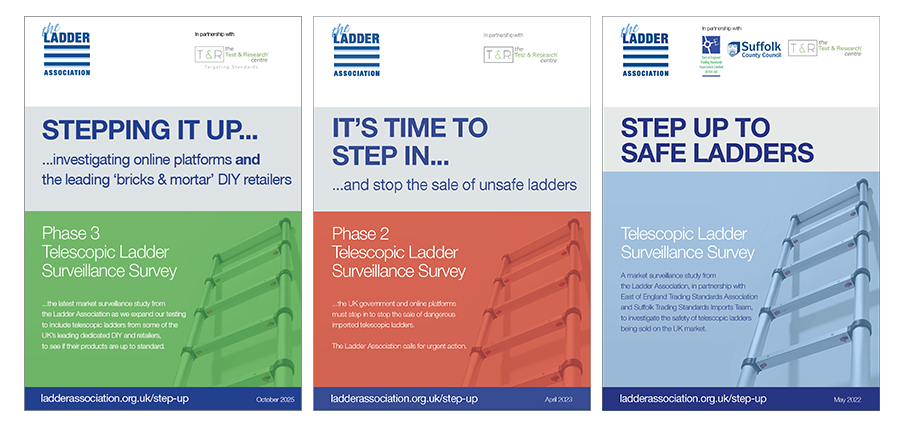
Phase 1 (report released May 2022): Partnership Surveillance Activity
In September 2021, in partnership with the East of England Trading Standards Association (EETSA) and Suffolk Trading Standards Imports Team, the Ladder Association and Test & Research Centre embarked on our first telescopic ladder market surveillance study.
A total of 17 telescopic leaning ladders were tested:
The samples were put through their paces at T&R against a series of limited scope safety critical tests to investigate their conformity with product standard EN 131-6 (known in the UK as BS EN 131 Part 6).
The study revealed that 4 out of 5 telescopic ladders tested failed safety tests designed to protect users. These findings underscore the prevalence of unsafe ladders in the market.
Phase 2 (report released April 2023): Re-Testing Previously Failed Samples
In order to identify if the previous failures were ‘one-offs’, the Ladder Association asked the Test & Research Centre to re-test the 6 samples they selected and supplied for the Phase 1 study, following identical testing procedures against the same samples (or the closest available on the market at that time). While 1 sample was re-purchased from a physical store, the other 5 samples were bought from Amazon, eBay and OnBuy.com.
Of those telescopic ladders re-tested, 100% again failed the required safety tests, were non-compliant and were unsafe to use.
Phase 3 (report released November 2025): Testing Telescopic Ladders Bought via Online Marketplaces AND from Physical Stores
A total of 18 telescopic leaning ladders were tested as part of this latest product surveillance survey. All products were selected and supplied by the Ladder Association. All samples were obtained anonymously from a range of sources:
4 out of 5 ladders tested in this study, failed.
100% of the ladders bought from Online Marketplaces (being sold by third party sellers) FAILED the required safety tests, were non-compliant and dangerous.
100% of the ladders bought directly from Physical Stores PASSED the required safety tests, were compliant and safe to use.
The Test & Research Centre (T&R), a UKAS-accredited facility specialising in access equipment, partnered with the Ladder Association to conduct comprehensive testing. Their evaluations uncovered alarming deficiencies in many ladders, including:
These tests not only identified dangerous products but also provided evidence to support regulatory actions against non-compliant manufacturers and suppliers.
The campaign’s findings gained national attention, including a feature on BBC Morning Live. During the segment, three telescopic ladders purchased online were tested, and all failed the strength tests before the full load was applied. This exposure highlighted the urgent need for consumers to be vigilant and for stricter enforcement of safety standards.
The Ladder Association and T&R continue to advocate for:
Their joint efforts aim to ensure that only safe, compliant ladders are available to UK consumers.
“Making sure consumers are safe is our number one priority. We are aware of below-standard ladders being sold to unsuspecting consumers, particularly via online platforms and are committed to continue our market surveillance, in partnership with T&R and Trading Standards, to root out unsafe ladders, one step at a time.“
Peter Bennett OBE, Executive Director, The Ladder Association

The ‘Step Up to Safe Ladders’ campaign exemplifies the power of collaboration between industry bodies and testing experts.
Through rigorous testing, public awareness, and advocacy, the Ladder Association and the Test & Research Centre are making significant strides in eliminating unsafe ladders from the UK market and safeguarding users nationwide.
The Test & Research Centre was founded to help make access products and their users safer. We are committed to working with all stakeholders, including the Office for Product Safety and Standards and industry bodies like the Ladder Association, to ensure that users have access to products that conform with British and European Standards.
Do you import ladders like those in the BBC film? Contact us to find out how we can help you to validate your supply chain.
34 Regal Drive, Soham, Cambridgeshire, CB7 5BE.
A UK-based Certification Body, Test Laboratory and training facility that specialises in access equipment.