
Telescopic ladders are everywhere now; vans, lofts, under the stairs. Because they collapse down to almost nothing. That sliding mechanism is also exactly what makes them different to worry about. BS EN 131‑6:2019 is the part of the EN 131 family that deals specifically with leaning and standing telescopic ladders. It sits alongside EN 131‑1 (terms and sizes), EN 131‑2 (general requirements and testing), and EN 131‑3 (marking and user instructions), and adds the locking, squeezing and clearance rules that a fixed-rung ladder simply doesn’t need. This article explains what it covers, in plain English.
Telescopic ladders don’t just have to be strong. Every rung/step section has to lock reliably, every time, or the whole thing is a hazard. The standard exists because a telescopic ladder introduces failure modes a rigid ladder doesn’t have: a section that doesn’t lock, fingers caught as it collapses, or a top rung pressed hard against a wall with nowhere for it to sit properly.
And the market evidence backs that up. Ladder Association market surveillance testing has repeatedly found between 78–100% of telescopic ladders they sampled fail basic safety requirements (tested at Test & Research Centre). Locking mechanisms that don’t engage, or false EN 131 marking on products that were never tested against it, are the recurring themes. EN 131‑6 is the benchmark those products are failing against.
You can read more in our Ladder Association Case Study >
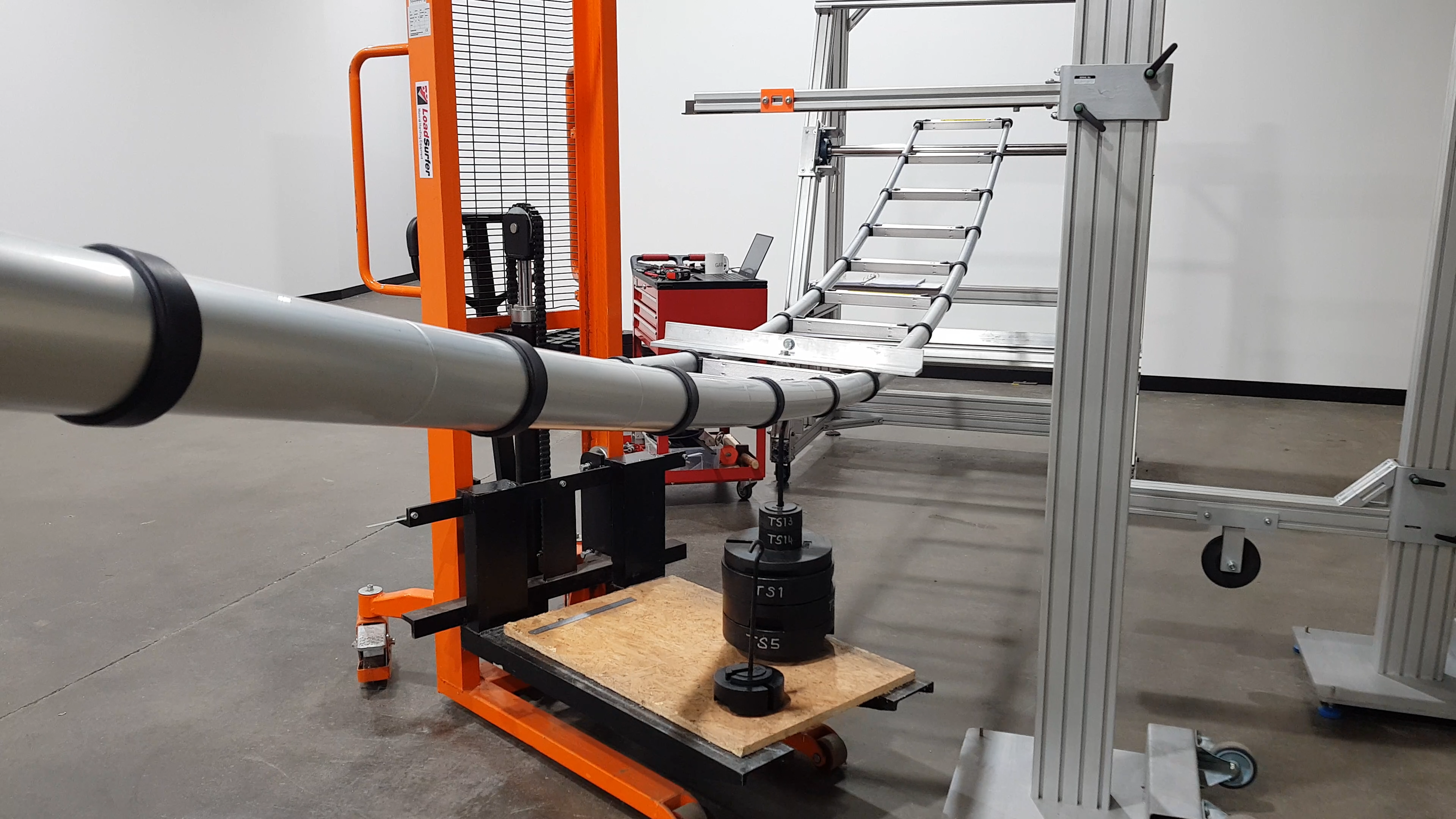
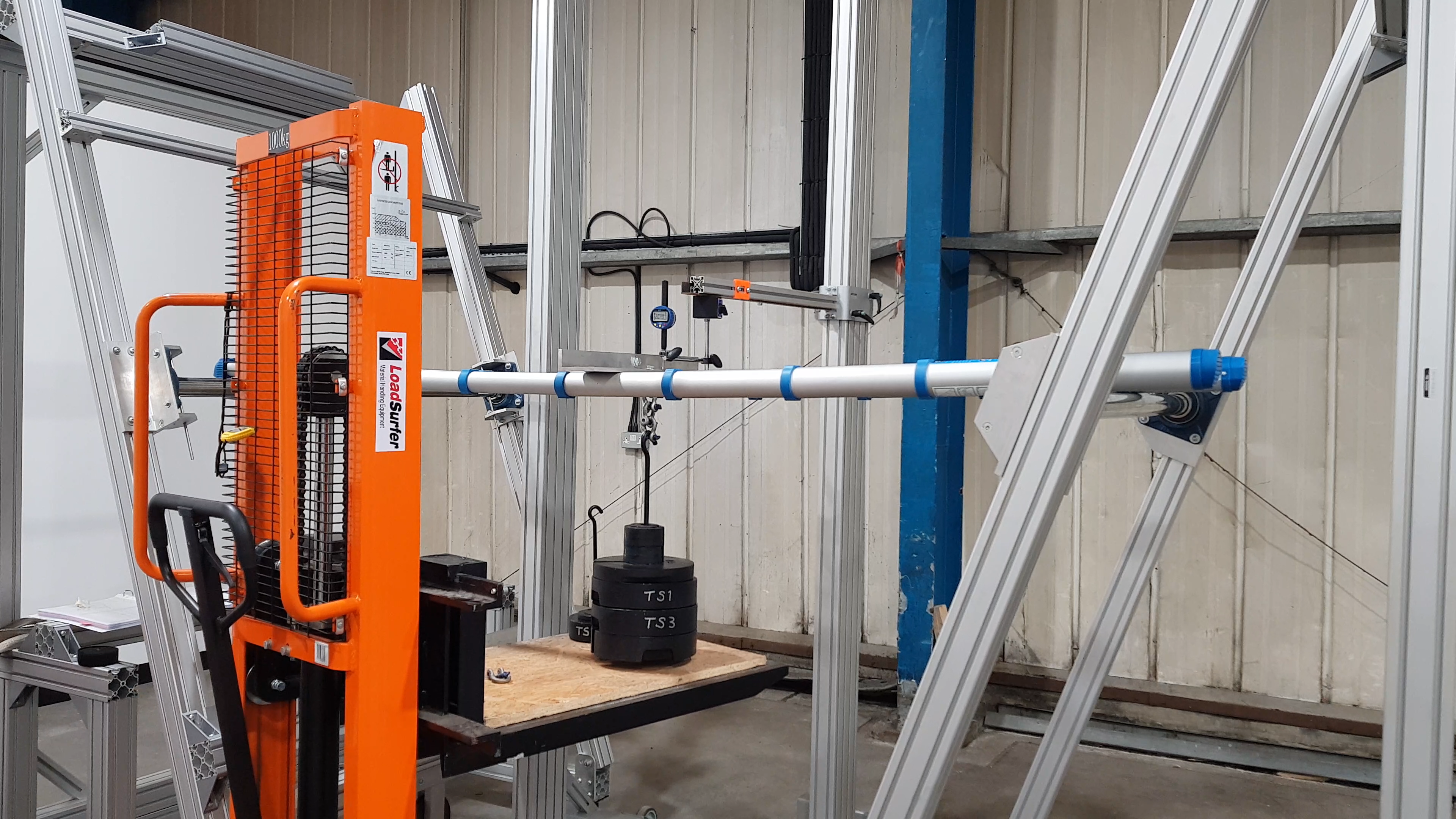
The standard covers leaning and standing telescopic ladders, defined as ladders made of three or more rung/step sections with telescopic stiles. Ladders with extension elements (push‑up or rope‑operated type) are not covered here. Those fall under EN 131‑1 and EN 131‑2. Where a telescopic ladder also has a hinge joint (so it can be used folded, stood free, or as a stand‑off ladder), the hinge‑joint requirements of EN 131‑4 apply on top.
| Term | Simplified definition |
|---|---|
| Telescopic ladder | A ladder made of three or more rung/step sections with telescopic stiles. |
| Hinge‑joint telescopic ladder | A telescopic ladder that also has one or more hinge joints with at least one lockable position. |
| Rung/step section | One rung or step connected to two telescopic stiles. |
| Rung/step bracket | The part that attaches the rung/step to the stile. |
| Locking mechanism / locking pin | The mechanism that locks each rung/step section in place, and the pin that engages when it's locked. |
| Locking indicator | The visible mechanism or part that shows whether a section is locked or unlocked, e.g. a coloured band on the pin. |
| Protection against squeezing | A mechanism or feature (such as a braking function or a distance device) that stops fingers being trapped as the ladder collapses. |
| Release function | The function that releases the locking mechanism so a section can slide. |
| Ascendable part | The part of the ascending leg made up only of fully extended rung/step sections. |
| Storage position | The position where none of the rung/step sections are extended. |
Two dimensions are specific to telescopic ladders. Top rung clearance (l₆) is the horizontal gap between the top rung and the wall when the ladder is in use at 65°–75°: it must be between 35 mm and 300 mm. Outside width (b₄) is the widest point of the stiles at the bottom of the ladder. For leaning telescopic ladders of 3 m or more, the base width formula from EN 131‑1 (b₂ = b₄ + 0.1 × l₁) still applies – this is why longer telescopic ladders flare out at the base.
EN 131‑6 puts a telescopic ladder through a longer sequence of tests than a fixed-rung ladder, precisely because there’s more that can go wrong. The key ones:
| Test | What it checks |
|---|---|
| Strength test of stiles | Ladder erected at 65°, test load applied to the centre rung and then the highest usable rung, for 1 minute: 2,250 N non‑professional, 2,700 N professional. |
| Vertical load on rungs/steps and platforms | After a 200 N pre‑load, a 2,600 N load is applied to the weakest rung, step or platform. Permanent deformation must be ≤0.5% of the inner width. |
| Rungs/steps strength test – unlocked position | The locking mechanism on the top usable section is deliberately unlocked, then a 2,600 N vertical load is applied, checking the ladder doesn't fail catastrophically if a section isn't engaged. |
| Pull‑out test of rung/step | Three rungs (centre, top third, bottom) are pulled in the longitudinal direction up to at least 2,600 N to check the rung‑to‑stile fixing. |
| Cyclic test of locking mechanism | The bottom two sections are extended, loaded, released and closed 4,000 times, with no lubricant added, to check the locking mechanism doesn't wear out or start failing to engage. |
| Static test of locking mechanism | Ladder fully extended and vertical; 3,500 N applied at the top of each stile in turn for 1 minute. |
| Opening and closing cycle test | 4,000 full open/close cycles at no more than 200 mm/s, checking the locking indicator, locking mechanism and squeeze protection all still work afterwards. |
Hinge‑joint telescopic ladders also get the EN 131‑4 hinge cycling test. Feet, end caps, bending, lateral deflection and bottom stile ends are tested to the general EN 131‑2 methods.
Two rules are specific to telescopic ladders and worth knowing even if you’re not the one writing the label. The marking has to explain how the locking/unlocking function works (by text or symbol), and it has to show which side is the ascendable side. Critically: in the leaning ladder position, the user must not stand on the top 1m. That instruction has to appear both in the user manual and as marking on the ladder itself.
EN 131‑6 exists because a telescopic ladder is a different kind of product to a rigid one – the same rung has to lock safely thousands of times, not just hold a load once. The standard’s testing regime is built around that: locking mechanisms cycled 4,000 times, sections deliberately tested unlocked, and clear rules on how the user is told what’s locked and what isn’t. Given how consistently telescopic ladders on the open market are failing surveillance testing, EN 131‑6 marking properly earned, not just printed, is the single clearest signal of a product you can trust.
Find out more about the Ladder Association’s ongoing ‘Step Up to Safe Ladders’ campaign, including freely downloadable market surveillance reports and testing videos – ladderassociation.org.uk/step-up/
Plus, stay up to date with ladder standards and safe work‑at‑height practices, consult these authoritative organisations:
34 Regal Drive, Soham, Cambridgeshire, CB7 5BE.
A UK-based Certification Body, Test Laboratory and training facility that specialises in access equipment.